Close

Plan Your Escape
Nestled on the sun-kissed cliffs overlooking the sparkling sea, Villa Fiorentino invites you to experience timeless elegance and pure relaxation.
.webp)


Close
Nestled on the sun-kissed cliffs overlooking the sparkling sea, Villa Fiorentino invites you to experience timeless elegance and pure relaxation.
Positano's cliffs are seductive, but they are not the whole story of this coast. An hour and a half south, past Agropoli's harbor and into hills terraced with olive groves and fig trees, Cilento unfolds like the region's undiscovered half: long white beaches without a single beach club in sight, Greek temples still standing after twenty-five centuries, and a table set with buffalo mozzarella so fresh it barely survives the drive home. It is close enough to visit in a day and different enough to feel, for a few hours, like you have left the postcard behind for something wilder.
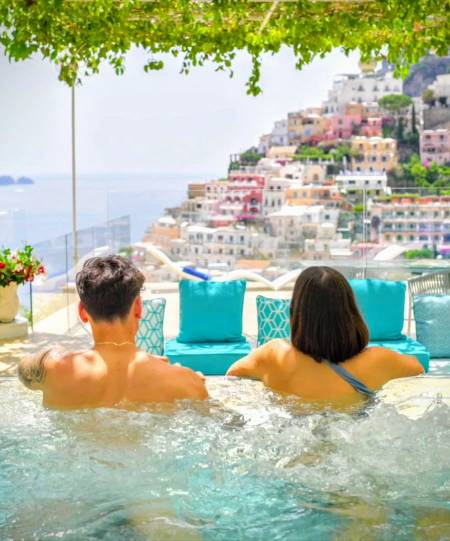
Villa Fiorentino's concierge can arrange a private driver and a loose itinerary for the day: Paestum's temples in the cool of the morning, a swim in a cove the road doesn't quite reach, a long lunch built around whatever the sea and the dairy produced that morning. You'll be back on the cliffside by evening, sun-warmed and pleasantly overfed, in time for a drink at the infinity pool as the light turns gold over the Tyrrhenian.
Cilento takes its name from the Latin cis Alentum, "this side of the river Alento," and the land still feels like a place apart. Inland it climbs into limestone mountains; along the water it breaks into inlets, headlands, and sea caves carved by centuries of karst erosion, fed by freshwater springs that surface unexpectedly at the base of cliffs. Almost all of it lies inside the Cilento, Vallo di Diano and Alburni National Park, 181,048 hectares that fold in two marine protected areas, Santa Maria di Castellabate and Costa degli Infreschi, where the water is clear enough to make snorkeling feel unnecessary — you can already see everything from the surface.
The credentials back up the scenery. UNESCO added Cilento to its network of biosphere reserves in 1997 and to the World Heritage list the following year, and in 2010 the park became the first in Italy to be recognized as a UNESCO Global Geopark. None of that shows up as crowds. It shows up as empty coves.
Cilento is what the Amalfi Coast looked like before anyone came looking for it — the same turquoise water and golden stone, but empty enough to feel like a discovery.
Founded by Greek colonists as Poseidonia, named for the god of the sea, Paestum is the reason most people first hear the word Cilento. Its three Doric temples, dedicated to Hera, Athena, and Neptune, have stood in the same field for roughly 2,500 years and are among the best preserved anywhere outside Greece — go early, before the tour buses arrive, and the columns catch the morning light with almost nobody else around. Wander on through the Roman forum, amphitheater, and domus, and if you have time for one more stop, the Paleochristian basilica nearby rewards the detour.
Save an hour for the National Archaeological Museum, home to the Tomb of the Diver, and an hour more for the sea: the beaches of Capaccio-Paestum unfurl in wide stretches of golden sand backed by pine forest, and the strip near the ruins, Torre di Paestum, comes with its own oddity — a watchtower and, just beyond it, a WWII-era bunker half buried in the dunes.
Agropoli guards the northern gate to Cilento from a promontory topped by its Angevin-Aragonese Castle, its lanes threading past the old Fornace — once a brick factory, now a cultural center — down to a working harbor with some 1,200 berths, the largest south of Salerno. The Bay of Trentova and the San Marco waterfront earned the town a Blue Flag for water quality, which is the polite way of saying: swim here without a second thought.
Half an hour on, Acciaroli trades castle walls for a fisherman's quiet. Its 13th-century Norman tower stands at the mouth of the harbor, and from its base at sunset the whole coastline turns copper. Researchers have spent years studying the unusual number of centenarians who live here, crediting a lifetime of the same Mediterranean diet you're about to sit down to at lunch — fresh fish, good oil, and unhurried afternoons by the water.
Further south, the coast turns properly wild. Marina di Camerota's karst shoreline hides a string of sea caves once used as shepherds' shelter — the Grotta dell'Autaro, the Grotta del Pesce, the Grotta della Cala, nicknamed the Cave of Prehistoric Man for what was found inside — and beaches that range from the easy, car-accessible Lentiscelle to the Calanca, reached down a steep staircase and worth it for families thanks to its shallow water. Beyond them sits Baia degli Infreschi, a marine reserve, and Cala Bianca, a white-sand beach reachable only by boat that Legambiente named Italy's most beautiful beach in 2013.
Ten kilometers on, Palinuro closes out the day with sea and hillside in equal measure. Boats slip into the Grotta Azzurra, a blue-lit sea cave, and along Capo Palinuro's coast, and the Arco Naturale — a rock arch framing the meeting point of the Mingardo river and the open Tyrrhenian — remains the headland's signature view, especially from the water looking back toward shore.
Cilento is one of the places where the Mediterranean Diet was first studied and codified, and it shows in every course. Start with Mozzarella di Bufala Campana D.O.P. from the Piana del Sele, best eaten within hours of being made, or seek out the local variation known as mozzarella in la mortella, wrapped and preserved in wild myrtle — the Taverna del Mozzo in Marina di Camerota still prepares it the traditional way. Add the Paestum artichoke I.G.P., Cilento's white figs D.O.P. stuffed with dried fruit or dipped in dark chocolate, and whatever the day's catch happens to be, and you'll understand why the typical dishes of this coast rarely need much dressing up.
What ties every plate together is the region's extra virgin olive oil, poured with a generosity that borders on ceremony, and a glass of something local: Cilento's own Aglianico, Falanghina, Fiano, or Rosato, grown on the same volcanic hillsides you'll have spent the morning driving through.
Villa Fiorentino's concierge handles the private driver, the boat into Cala Bianca or the Grotta Azzurra, and the lunch reservation, so the only real decision is what time to be back for aperitivo on the cliff. Get in touch to build a Cilento day trip around your stay, or browse our suites before you go.

Villa Fiorentino Lifestyle is located in one of the most scenic areas of Positano and the Amalfi Coast. Enjoy your stay with us.


.svg)
.svg)
.svg)

.svg)

.jpg)